Span tables updated November 2026
- Cedar Park builds to the 2021 IRC. In southern pine at 16 inches apart, a 2x8 joist can span 11 feet 10 inches and a 2x10 can span 14 feet.
- The overhang past the beam is set by the back span. A 2x10 pine joist with a 12 foot back span can hang out 3 feet.
- Some charts online still print the 2018 numbers. For fir and SPF 2x6 joists, the 2021 limits run shorter.
A 2x8 joist and a 2x10 joist look close on the lumber rack, but on a deck they're 2 feet apart. In southern pine set 16 inches on center, the 2021 code lets a 2x8 run 11 feet 10 inches and a 2x10 run 14 feet. We see that gap trip up deck plans more than any other number. A 12 foot deck framed with 12 foot 2x8s and the beam at the outer edge sits right over the line.
How Far Can a Deck Joist Span?
The span is the distance a joist runs between supports, usually from the ledger on the house to the beam. The limit depends on three things. Those are the wood species, the joist size and how far apart the joists sit. Cedar Park adopted the 2021 International Residential Code on June 1, 2022, with local changes, according to the city's building permits page. Table R507.6 in that code sets the spans below.
| Species and size | 12 in. apart | 16 in. apart | 24 in. apart |
|---|---|---|---|
| Southern pine 2x6 | 9 ft 11 in | 9 ft 0 in | 7 ft 7 in |
| Southern pine 2x8 | 13 ft 1 in | 11 ft 10 in | 9 ft 8 in |
| Southern pine 2x10 | 16 ft 2 in | 14 ft 0 in | 11 ft 5 in |
| Southern pine 2x12 | 18 ft 0 in | 16 ft 6 in | 13 ft 6 in |
| Fir, hem fir or SPF 2x6 | 9 ft 6 in | 8 ft 4 in | 6 ft 10 in |
| Fir, hem fir or SPF 2x8 | 12 ft 6 in | 11 ft 1 in | 9 ft 1 in |
| Fir, hem fir or SPF 2x10 | 15 ft 8 in | 13 ft 7 in | 11 ft 1 in |
| Fir, hem fir or SPF 2x12 | 18 ft 0 in | 15 ft 9 in | 12 ft 10 in |
The code's notes say these numbers assume No. 2 grade lumber, a wet service factor and a 10 psf dead load. Redwood, western cedar and ponderosa pine get their own shorter rows in the same table. If your plan falls between two rows, the code allows you to interpolate but not to stretch past the last column.
Which Rows Fit the Lumber in My Yard?
Read the grade stamp on the side of the board. If it says SYP or southern pine, use the top half of the table. If it says hem fir, SPF or Douglas fir, use the bottom half, since those spans run shorter. A board without a No. 2 stamp or better doesn't meet the code's lumber rule at all.
Do the Snow Load Rows Matter in Cedar Park?
The table has a second block for a 50 psf ground snow load. The code says to design a deck for the live load or the ground snow load, whichever is greater. That second block is built for places where snow piles up all winter. The National Weather Service's Austin climate summary puts the area's record snowstorm at 11 inches, in November 1937. For a deck here, the 40 psf live load rows are the ones to plan from.
Why Do Some Span Charts Show Longer Numbers?
Many charts online were built from the 2018 code. The joist rows for southern pine didn't move. Some fir and SPF rows did. The 2018 table, still posted on UpCodes for Texas, lets a fir or SPF 2x6 run 8 feet 8 inches at 16 inches apart. The 2021 table Cedar Park uses cuts that to 8 feet 4 inches. At 24 inches apart it drops from 7 feet 2 inches to 6 feet 10 inches.
That's only a few inches. It still matters when the plan reviewer checks your drawing against the 2021 numbers. If a chart doesn't say which code year it came from, check it against the table above before you buy lumber.
Do I Need 2x8 or 2x10 Joists for My Deck?
Measure how far the joists have to run, then find the smallest size that covers it with a little room. The 12 by 16 foot deck in our Cedar Park deck cost guide makes a good test. It runs 12 feet out from the house on 2x8 joists, 16 inches apart, with a doubled 2x10 beam on four posts.
Put that beam right at the outer edge and each joist spans close to its full 12 feet. A southern pine 2x8 at 16 inches stops at 11 feet 10 inches, so that layout is over the limit. There are three clean fixes.
| Fix | Joist span | Code limit | Extra cost, worked example |
|---|---|---|---|
| Set the beam 1 foot in from the edge | About 11 ft, with a 1 ft overhang | 11 ft 10 in | None |
| Keep 2x8s, set them 12 inches apart | About 12 ft | 13 ft 1 in | About $95 for 4 more joists and 8 more hangers |
| Switch to 2x10 joists at 16 inches | About 12 ft | 14 ft 0 in | About $113 more in joist lumber, plus larger hangers |
The cost column is our own math from shelf prices at the Cedar Park Home Depot on October 31, 2026, listed in the cost guide. A 12 foot 2x8 was $18.18 and a joist hanger was $2.83. A 16 foot 2x8 was $23.38 and a 16 foot 2x10 was $34.98, so we priced the 2x10 switch at those per foot rates. Your own yard will price out differently.
Moving the beam in costs nothing and also hides the beam a bit under the deck. The 2x10 joists give you the stiffest floor and room to add a hot tub pad or planters later. A hot tub is a load these tables don't cover. The code sends any deck outside its set rules back to its general design section, which usually means an engineer.
How Far Can a Joist Hang Past the Beam?
A cantilever is the part of the joist that runs past the beam. The 2021 code ties the limit to the back span, which is the joist span behind the beam. A longer back span lets the joist hang out farther, up to a point. Past that point the overhang isn't allowed at all.
| Joist | 6 ft back span | 8 ft | 10 ft | 12 ft | 14 ft |
|---|---|---|---|---|---|
| 2x6 | 1 ft 6 in | 1 ft 5 in | Not allowed | Not allowed | Not allowed |
| 2x8 | 1 ft 6 in | 2 ft 0 in | 2 ft 6 in | 2 ft 3 in | Not allowed |
| 2x10 | 1 ft 6 in | 2 ft 0 in | 2 ft 6 in | 3 ft 0 in | 3 ft 4 in |
| 2x12 | 1 ft 6 in | 2 ft 0 in | 2 ft 6 in | 3 ft 0 in | 3 ft 6 in |
Take the 2x8 joist in our test deck with an 11 foot back span. The table lands between 2 feet 6 inches and 2 feet 3 inches, so a 1 foot overhang passes with room to spare. A 2x8 with a 14 foot back span is already past its span limit, which is why that box reads not allowed.
The overhang also pulls up on the house end of the joist. The code says a deck with cantilevered joists has to resist that uplift where it attaches to the house. That's one more reason the ledger bolts matter.
How Far Apart Should the Posts Be Under the Beam?
The beam carries the joists, and the posts carry the beam. Tables R507.5(1) through R507.5(4) set how far a beam can run between posts. To use them, you first find the effective joist span. That's the real joist span times a factor from Table R507.5(5), which goes from 0.66 with no overhang up to 1.00 when the overhang is a quarter of the span.
| Beam | 6 ft effective joist span | 8 ft | 10 ft | 12 ft |
|---|---|---|---|---|
| Doubled 2x8 | 8 ft 9 in | 7 ft 7 in | 6 ft 9 in | 6 ft 2 in |
| Doubled 2x10 | 10 ft 4 in | 9 ft 0 in | 8 ft 0 in | 7 ft 4 in |
| Doubled 2x12 | 12 ft 2 in | 10 ft 7 in | 9 ft 5 in | 8 ft 7 in |
| Tripled 2x10 | 13 ft 0 in | 11 ft 2 in | 10 ft 0 in | 9 ft 2 in |
Back to the test deck. An 11 foot joist span with a 1 foot overhang is a ratio just over 1 to 12. The next row up in Table R507.5(5) is 1 to 10, with a factor of 0.80. That gives an effective span of about 8.8 feet. Read from the safer 10 foot column, a doubled 2x10 can run 8 feet between posts. Four posts along 16 feet leave gaps of about 5 feet 4 inches, well inside that limit.
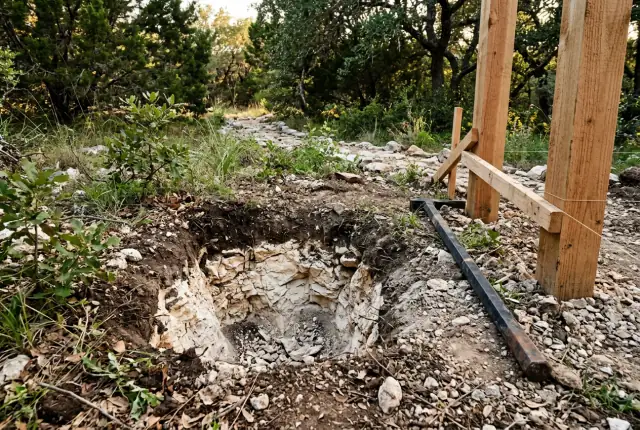
The code also lets a beam hang past its end posts by up to a quarter of its span. Each post then sits on a footing sized for the load above it. In much of Cedar Park that footing is cut into rock. Our guide to building on limestone covers that dig.
What Changes With Composite or Diagonal Boards?
The joist span table tells you how far each joist can run. The decking on top tells you how close together the joists have to be. For wood boards, Table R507.7 sets that spacing for the two common thicknesses.
- 5/4 wood boards laid straight across three or more joists can sit on joists 16 inches apart. Laid on a diagonal, the joists close to 12 inches.
- 2 inch thick wood boards can sit on joists 24 inches apart when laid straight across.
- Composite boards follow the span printed on their label, which the code requires on the board or its package.
Trex's joist guide calls for joists no more than 16 inches apart under its boards, and 12 inches for a diagonal pattern. On an old frame set 24 inches apart, Trex suggests adding a joist between each pair. That's a common catch when a Cedar Park owner swaps worn pine for composite decking on the same frame. Our deck board spacing guide covers the gaps between the boards themselves.
What Does the City Check on the Framing?
Cedar Park wants a permit for a deck 30 inches or more off the ground, over 200 square feet, or tied to the house. The plan you send shows the joist size, spacing and span, the beam and the posts. The Cedar Park deck permit guide lists the drawings and the inspections. A few framing rules from the 2021 code catch people at inspection.
- Joist ends need at least 1 1/2 inches of bearing on wood or metal, and 3 inches on masonry.
- A joist that frames into the side of a beam or ledger has to sit in an approved hanger.
- Blocking or hangers that keep joists from rolling must be at least 60 percent of the joist depth.
- A beam that joists sit flush with must be at least as deep as those joists.
We'll measure your yard, size the joists and beam to the 2021 tables and draw a frame that passes the first time. Ask for a free estimate.
Move Cedar Park Deck Builders up in your Google results
Source Material
| What we cited | Where it came from |
|---|---|
| Joist spans, overhang limits by back span, beam spans, joist span factors, decking spacing, bearing, hangers, blocking, uplift, live load and snow load rule | International Code Council, 2021 International Residential Code, Chapter 5, Section R507 |
| Cedar Park's adopted codes and their June 1, 2022 start date | City of Cedar Park, Building Permits and Inspections |
| The 2018 joist span numbers for fir and SPF | UpCodes, R507.6 Deck Joists, 2018 Texas residential code |
| Joist spacing under composite boards and the fix for 24 inch frames | Trex, How to Space and Install Deck Joists |
| Record Austin area snowstorm | National Weather Service Austin and San Antonio, Austin Climate Summary |
| Test deck layout and lumber and hanger prices | Our deck cost guide, which names the store and the day we checked |