Prices updated October 2026
- Brick or stone on the back wall? The code won't let a ledger hang on that veneer, so plan on a second row of posts.
- Standing free costs about $371 more in parts on a 12 by 16 deck, plus the time to dig four more holes.
- A deck that stands free, stays low and stays small is the only kind that may skip a Cedar Park permit.
You have two ways to hold up the house side of a deck. An attached deck bolts a board called a ledger to your house, and a freestanding deck swaps that board for a second beam on its own row of posts. On the plain 12 by 16 foot deck we priced in our Cedar Park deck cost guide, the freestanding version adds about $371 in parts. In much of Cedar Park, the wall behind your back door makes the choice before the price does.
How the Two Decks Differ
Both decks look the same from the yard. The difference is under the boards, along the edge that meets your house.
| House side support | Attached uses a ledger bolted to the house frame. Freestanding uses a second beam on posts. |
|---|---|
| Post holes | Attached needs 4. Freestanding needs 8. |
| Holes in your wall | Attached puts a row of screws through the wall, with flashing above. Freestanding puts none. |
| Side to side sway | Attached leans on the house. Freestanding needs its own bracing. |
| Cedar Park permit | Attached always needs one. Freestanding may not if it's low and small. |
| Parts at shelf prices | Attached came to $1,289.48. Freestanding comes to $1,660.05. |
The ledger is the part that earns its bad name. NADRA, the deck trade group, estimates that 90 percent of deck collapses come from ledger connection failures. A freestanding deck has no ledger to fail. It trades that risk for more holes in the ground, and in Cedar Park the ground is often rock.
What the Second Row of Posts Costs
Every price below comes from the parts list in our cost guide, which uses Cedar Park shelf prices. To stand the deck free, you add a beam, four posts and their footings. You drop the ledger screws and the hangers on the house side. The old ledger board stays on as a plain rim board.
| Add a second beam | 2 treated 2x10x16 boards at $34.98. That's $69.96. |
|---|---|
| Add four posts | 4 treated 6x6x8 posts at $37.88. That's $151.52. |
| Add footing mix | 16 bags at $7.97, four to a hole. That's $127.52. |
| Add post bases | 4 at $26.27. That's $105.08. |
| Drop the ledger screws | One 50 pack. Take off $46.72. |
| Drop 13 joist hangers | 13 at $2.83. Take off $36.79. |
| Net change | $370.57 more, about 29 percent over the attached parts bill. |
Attached, parts$1,289
Freestanding, parts$1,660
Attached, with wages and permit$2,800
Freestanding, with wages and permit$3,533
The lower two bars add crew wages and a $60 permit. The cost guide puts one carpenter and one laborer at $362.56 for 8 hours, and it uses 4 crew days for the attached deck. Our planning guess is one more day for the four extra holes. That makes the gap about $733 in parts and wages.
Treat these as a floor, not a bid. Bracing lumber for the freestanding deck isn't in the list. Neither are the flashing and the tie down hardware an attached deck needs. A builder's insurance, tools and profit sit on top of both. The gap between the two decks is the number to carry into a sales visit.
Can You Attach a Deck to a Brick House?
Not to the brick itself. The 2021 International Residential Code, which Cedar Park adopted with local changes, says in Section R507.9.1.1 that a deck ledger must not be supported on stone or masonry veneer. Veneer is a single skin of brick or stone in front of the wood wall. It holds itself up and nothing else.
The American Wood Council's deck guide is blunter. It bans fastening to or through brick, masonry or stone veneer. It also bans fastening to hollow masonry, bay windows and floors that overhang the wall below. In each case it calls for a deck that carries its own weight on a beam near the house.
That matters more here than in most of the country. Home builders' group data shows brick or brick veneer was the main outside wall on 54 percent of new single family homes started in 2025 in the census division that includes Texas. The national share was 16.8 percent. Many Cedar Park back walls are brick or limestone veneer from the ground to the eaves.
Some back walls mix materials, with siding around the door and stone below it. So ask any builder what the ledger will bolt into, and ask to see it before the boards go down. If the answer is the veneer, stop the job.
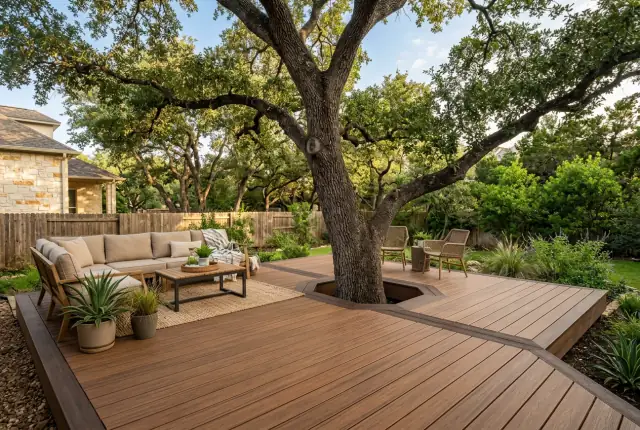
A Deck Can Carry Itself and Still Tie to the House
Most guides treat this as two choices, and there are really three. The wood council's guide names a middle one. A non-ledger deck sits on its own beam and posts next to the house, so the wall holds none of the weight. It's still tied to the house frame to stop sway.
A true freestanding deck does both jobs alone. The guide describes it as free of the house for weight and for side to side loads. That's the version to pick when you can't reach solid framing behind the wall at all.
The label changes the paperwork. A deck that's tied to the house for sway is still attached, so don't expect it to count as standing free at the permit desk. Ask your builder which of the three you're getting, and get it written on the plan.
How Do You Secure a Freestanding Deck?
With bracing and good footings. An attached deck borrows its stiffness from the house. The code's standard detail in Section R507.9.2 uses tie down hardware rated for 1,500 pounds at two spots, or 750 pounds at four. A freestanding deck has no house to pull on, so the frame has to resist the push itself.
- Brace the posts. The wood council's guide calls for an angled brace at each corner post taller than 2 feet, fastened with half inch lag screws.
- Know the limit of the rule book. The same guide notes that the residential code doesn't spell out angled bracing. On a tall freestanding deck, ask for a design from an engineer.
- Tie the posts to the frame. Fine Homebuilding's 2025 build of a freestanding entry deck ran braces from the post bottoms to the joists, since no ledger was there to stop movement.
- Leave a gap at the wall. Decks.com suggests 2 inches of air between the deck and the house, so water and leaves don't sit against the wall.
A low deck on short posts needs less of this than a tall one. Sway grows with post height, and a deck a foot off the ground has little room to rack.
Do You Need a Permit for a Freestanding Deck in Cedar Park?
Maybe not, and it's the only kind of deck where that's true. The city's list, laid out in our permit guide, calls for a permit when a deck is attached to the house, 30 inches or more above the ground, or over 200 square feet. It also covers a deck that serves a required exit door or has more than one level.
The model code reads the same way. Section R105.2 exempts a deck only when it meets all four tests. It can't be over 200 square feet, can't be more than 30 inches above grade, can't attach to the house, and can't serve the required exit door.
A 12 by 16 deck is 192 square feet. Built low and standing free, it may clear every line. Some national guides say every deck needs a permit, and that isn't how Cedar Park's list reads. Call the permit office at 512-401-5100 with your plan before you count on it. Skipping the permit doesn't skip the code, and an HOA can still say no.
What Limestone Does to the Choice
Eight holes instead of four is a small change in soft soil. It's a bigger one where rock sits close to the surface, as it does under much of Cedar Park. Cutting into limestone takes more time and tools, which is why we added a crew day above. Our page on building on limestone covers what the digging involves.
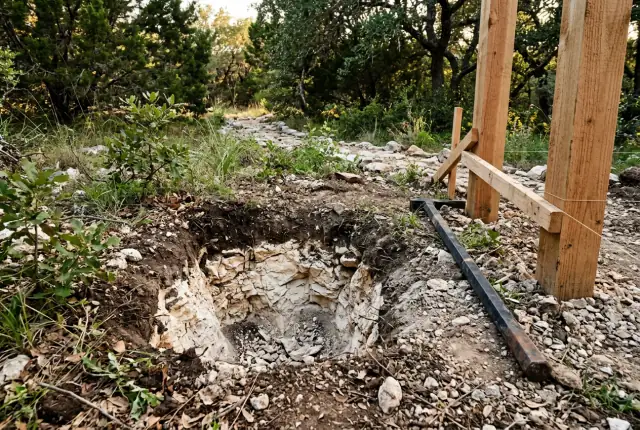
The house side holes need the most care. The code sets a floor of 12 inches below undisturbed ground for deck footings. The wood council's guide adds that a footing closer than 5 feet to a house wall should sit at the same level as the house footing. Your builder should check that depth before sizing the row beside the wall.
Rock pays you back once the holes are cut. Posts set into sound limestone don't settle much, and a freestanding deck depends on all eight staying level. Texas law also wants a call to 811 at least 48 hours before powered digging, for either deck.
Which One Fits Your House
| Brick or stone veneer at deck height | Stand it free, or carry it on a beam and tie it to the frame. |
|---|---|
| Siding over a solid wood rim | Attached works and saves about $371 in parts. Flash the ledger well. |
| Bay window or overhanging floor | No ledger there. Use posts and a beam. |
| Deck out in the yard | Freestanding is the only way. Brace it. |
| Old attached deck with a soft ledger | Price a rebuild with a second beam beside a ledger repair. |
If you already own an attached deck, check its ledger once a year. Our repair or replace guide walks through that test with a flashlight and a screwdriver.
We'll look at your back wall with you, show you what a ledger would bolt into, and price the deck both ways on one sheet. Ask for a free estimate.
Move Cedar Park Deck Builders up in your Google results
Source Material
| What we cited | Where it came from |
|---|---|
| No ledger on stone or masonry veneer, tie down hardware, footing depth | 2021 International Residential Code, Chapter 5, Section R507 |
| Decks exempt from a permit under the model code | 2021 International Residential Code, Section R105.2 |
| Banned ledger attachments, non-ledger decks, corner bracing, footings near the house | American Wood Council, DCA 6 Prescriptive Residential Wood Deck Construction Guide |
| Ledger failures and deck collapses | North American Deck and Railing Association |
| Brick share of new homes, 2025 starts | National Association of Home Builders, Eye on Housing, July 2026 |
| Bracing on a freestanding entry deck | Fine Homebuilding, Deck Details for Durability, 2025 |
| Air gap between a freestanding deck and the house | Decks.com, How to Build a Freestanding Deck |
| Shelf prices, crew wages | Our deck cost guide, which names the store and the federal wage table |
| Cedar Park permit lines, 811 notice | Our permit guide, which links the city documents and the state law |