Prices updated October 2026
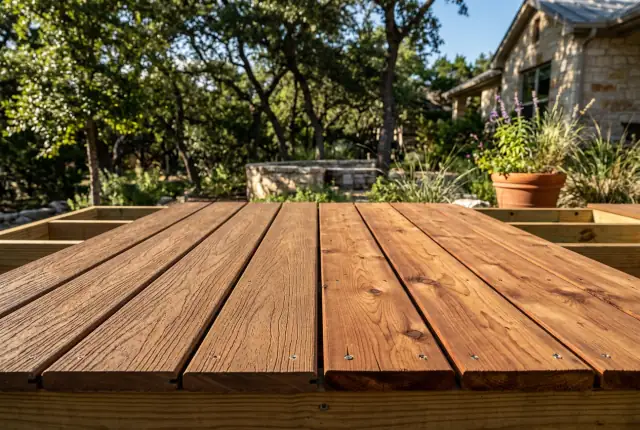
- Worn boards on a sound frame? Keep the frame. A new top runs about 37 percent of a new deck on this math.
- Soft ledger, rotten posts or many bad joists? Replace it. About $2,000 more buys the whole new frame.
- Frame past 15 years old? Get it checked before you pay for composite boards that can outlast it.
You have two real choices here, a new top on the frame you own or a whole new deck from the posts up. On the plain 12 by 16 foot deck we priced in our Cedar Park deck cost guide, a new treated pine top comes to about $1,157 in parts and crew wages. The whole new treated deck comes to about $3,162. The frame under your boards decides which one you're really shopping for.
What Each Job Costs on One 12 by 16 Deck
Every line uses the same low, attached deck and the same Cedar Park shelf prices from the cost guide. Crew wages are one carpenter and one laborer at middle Austin area pay, which comes to $362.56 for 8 hours. The crew days are planning guesses, since nobody can measure your job from a web page.
| Swap 5 bad boards | $98.87 in treated boards and screws, 1 crew day. About $461. |
|---|---|
| New treated pine top | $432.00 for 27 boards and screws, 2 crew days. About $1,157. |
| New Trex Enhance Basics top | $1,017.46 for 27 boards and the hidden clips, 2 crew days. About $1,743. |
| New treated deck | $1,289.48 in parts, 5 crew days with the tear off, $60 permit. About $3,162. |
| New Trex Basics deck | $1,934.88 in parts, 5 crew days with the tear off, $60 permit. About $3,808. |
Swap 5 boards$461
Treated top$1,157
Trex top$1,743
New treated deck$3,162
New Trex deck$3,808
These totals are a floor for planning, not a bid. Dump fees, rails, sales tax, insurance and a builder's profit aren't in them. So a fair written price will land well above each line. The value is in the gaps between the lines, because those hold up once the extras are added to both sides.
About $2,000 Buys the New Frame
Take the treated top away from the new treated deck, and the difference is $2,005. That money is $857 in framing parts, three more crew days at $1,088, and a $60 permit. The Trex comparison lands within $60 of it, at $2,065.
That's the number to keep in your head during a sales visit. When someone quotes you a new top, ask what the frame is good for. If the answer is vague, you're choosing between a cheaper job now and a bigger one soon, and only about $2,000 in parts and wages sits between them.
A new frame also resets the clock on every part you can't see. Posts, beam, joists and ledger all start at year zero together. That's hard to do in pieces, since most frame repairs start by lifting boards off.
Why the 50 Percent Rule Isn't Enough
Bob Vila's guide gives the rule most people repeat. If repairs cost more than half of a replacement, replacing may be the better call. It's a fine first filter, and it's short on the question that costs the most money.
Run it on the table above. The treated top is 37 percent of a new treated deck. The Trex top is 46 percent of a new Trex deck. Both pass, whatever shape the frame is in. The rule never asks how long the part you're keeping will last.
Lifespan is where it goes wrong. The National Association of Home Builders study from 2007 puts a wood deck at about 20 years under ideal conditions, and at 10 to 15 years in the South. Bob Vila's guide puts composite boards at 20 to 25 years. Those are old, broad numbers, but the mismatch is plain. Pay for composite on a 14 year old frame, and the boards can outlive what holds them up.
| Frame under 10 years | Repair what failed. A new top in either material is usually a safe bet. |
|---|---|
| Frame 10 to 15 years | Test it first. Treated boards are a fair match if it passes. Fix the frame before composite. |
| Frame over 15 years | Price the rebuild beside the repair. Keep the frame only if a close check says it has years left. |
How to Test the Frame Yourself
You can learn most of this with a flashlight and a screwdriver. Pull a few boards only if you can't see from below.
- Start at the ledger, the board that ties the deck to your house. NADRA, the deck trade group, estimates that 90 percent of deck collapses come from ledger connection failures. Look for screws or bolts instead of nails alone, and for rust, cracks or a spongy feel.
- Poke the joist ends, beam and post bottoms. Decks.com says wood that crumbles, or lets a screwdriver sink past 1/8 inch with little push back, points toward replacement.
- Sight down each post. A lean or a sunken base is a frame problem, and new boards won't hide it.
- Measure the joist spacing if you want composite. Trex says 16 inches on center is standard, and diagonal boards need 12. At 24 inches, it suggests adding a joist in each gap.
- Push hard on every rail post and stair rail. Any movement in a rail is a safety fix, not a cosmetic one.
One soft spot usually means a repair. Rot in several places, or anything wrong at the ledger, moves you toward the replace column. Our deck repair page lists the same warning signs.
What Changes the Math in Cedar Park
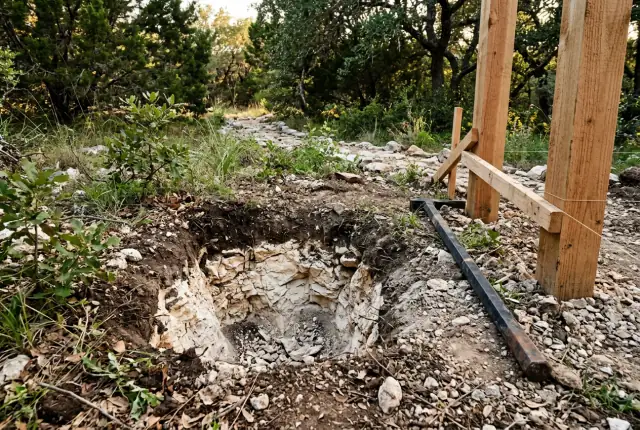
National cost pages can't price the ground under you. Much of Cedar Park sits on limestone close to the surface, and cutting a post hole into rock takes more time and tools. Sound footings that stay in place are worth more here than in soft soil. Read building on limestone before you assume new holes are a small line item.
Trees come next. Texas A&M Forest Service says to avoid pruning or wounding oaks from February through June, and it names construction as one way wounds happen. Paint any oak wound right away, in any month. A tear off beside a big live oak needs that plan in writing.
New holes also bring inspections and a call to 811 at least 48 hours before digging. The permit guide walks through those steps.
Do You Need a Permit to Replace Deck Boards?
Ask first, because the answer turns on your job. The city's guideline, as laid out in our permit guide, lists decks that are attached to the house, 30 inches or higher, or over 200 square feet. A full rebuild adds a structure again, so expect to need one. A small board swap is a question for the permit office at 512-401-5100.
The fee rarely decides this. The city code has no line that says deck, and a 12 by 16 comes to $60 on one row or $150 on another. Add $75 for each reinspection if a job fails.
How Much Does It Cost to Replace Rotted Wood on a Deck?
The wood is the cheap part. A treated deck board is $13.78 on the shelf and a Trex Basics board is $31.98. A 12 foot joist is $18.18. A post is $37.88, plus $26.27 for its base. Decks.com lists $25 to $85 in materials to replace loose or damaged boards yourself.
Labor is where the bill grows, since a rotted joist means the boards above it come off first. A bad post can also mean holding the beam up while it's changed. So get each repair priced as its own line, parts and labor apart.
Is Replacing a Deck Worth It?
It is when the frame has failed, because no top can fix that and you'd be paying for repairs on a deck you still can't trust. It usually isn't when the frame tests clean and only the boards look tired. In that case, a new top gets you most of the look for about 37 to 46 percent of the price, on the math above.
Can a Wood Deck Last 40 Years?
Don't plan on it. The home builders' study tops out at 20 to 30 years for wood decks, and that's for the North. It gives 10 to 15 for the South, and it says upkeep and climate swing the number widely. Treat anything past 20 years as a bonus, and check the ledger every year.
What Is the Best Time of Year to Replace a Deck in Cedar Park?
If oaks stand near your deck, aim for July through January. That keeps the tear off and any new post holes out of the February through June window the Forest Service warns about. With no oaks nearby, timing comes down to when your builder and the permit office can fit you in.
If the ledger is soft or a rail is loose, don't wait on the calendar. Stay off that part of the deck and get it looked at now. We'll go over your frame with you and price the repair and the rebuild side by side, so you can compare them. Ask for a free estimate.
Move Cedar Park Deck Builders up in your Google results
Source Material
| What we cited | Where it came from |
|---|---|
| The half of replacement rule, composite lifespan | Bob Vila, Is It Better to Repair or Replace a Damaged Deck? |
| Wood deck lifespan by region | NAHB and Bank of America, Study of Life Expectancy of Home Components, 2007 |
| Ledger failures and what to check | North American Deck and Railing Association |
| Screwdriver test, board repair materials | Decks.com, Deck Replacement and Repair Costs |
| Joist spacing for composite boards | Trex, How to Space and Install Deck Joists |
| Oak wounding months | Texas A&M Forest Service |
| Shelf prices, crew wages | Our deck cost guide, which names the store and the federal wage table |
| Permit lines, fees, inspections | Our permit guide, which links the city documents |