Prices updated October 2026
- Framing a 4 foot opening for the trunk adds about $120 in lumber to a 12 by 16 deck. The roots decide the rest.
- Keep every post hole out of the inner quarter of the root zone. On a 20 inch oak that's 5 feet from the trunk.
- Don't cut or scrape a live oak from February 1 through June 30, and paint any wound the minute it happens.
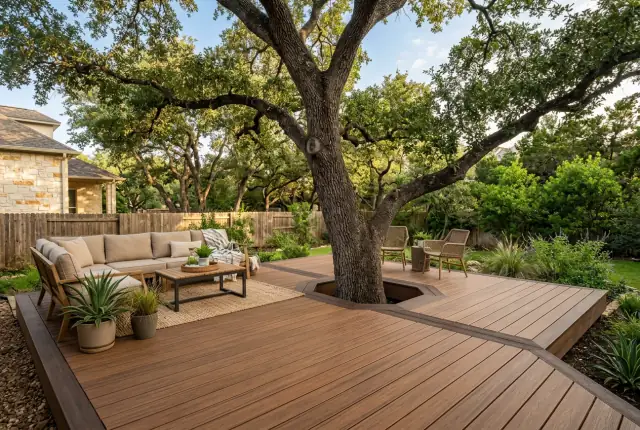
You have two ways to build a deck around a tree. You can wrap the trunk, with a framed opening in the deck floor, or you can stop the deck short and let the tree stand beside it. On the plain 12 by 16 foot deck we priced in our Cedar Park deck cost guide, the wrap adds about $120 in lumber. In Cedar Park the tree is most often a live oak, and its roots and the oak wilt calendar matter more than that lumber bill.
Wrap the Trunk or Stop Short
Both layouts keep the tree and both give you shade. They differ in where the posts land and how much of the deck you have to plan around growth.
| What you get | A wrap puts the trunk inside the deck. Stopping short leaves the tree at the edge. |
|---|---|
| Framing | A wrap needs a boxed opening with extra joists. Stopping short uses a plain frame. |
| Post holes | A wrap tempts you to dig close to the trunk. Stopping short keeps holes farther out. |
| Growth | A wrap needs boards you can trim back later. Stopping short needs nothing. |
| Leaves and acorns | A wrap collects them in the opening. Stopping short lets most fall beside the deck. |
| Extra parts on a 12 by 16 | A wrap adds about $120 in lumber. Stopping short adds $0. |
Neither layout bolts anything to the tree. A trunk moves in wind and gets thicker every year, so the deck has to stand on its own posts. Decks.com gives the same rule in its build steps, and it's the one rule every tree deck shares.
How Close Can a Deck Post Go to a Tree?
Start with the size of the trunk. Cedar Park's own tree rules, in Article 14.07 of the city code, draw a circle of one foot of radius for every inch of trunk width. The trunk is measured four and a half feet above the ground. The code calls that circle the critical root zone.
You don't need a special tool to measure. Wrap a tape around the trunk at that height and divide by 3.14. A trunk that measures 63 inches around is 20 inches wide, so its root zone reaches 20 feet out.
Cedar Park's article doesn't split the circle into rings for a backyard deck. Austin's does, and it makes a good yardstick. The City of Austin's residential tree page allows no impacts in the inner quarter of the zone. It allows no cut or fill deeper than 4 inches in the inner half. Across the full circle, half the ground has to be left alone.
| Trunk width | Tape reads about | Full zone | Inner half | Inner quarter |
|---|---|---|---|---|
| 12 inches | 38 inches | 12 feet | 6 feet | 3 feet |
| 20 inches | 63 inches | 20 feet | 10 feet | 5 feet |
| 30 inches | 94 inches | 30 feet | 15 feet | 7.5 feet |
Austin's rings are law in Austin, not here. Used as a planning rule, they give you a clear answer. Put no post in the inner quarter. Put as few as you can in the inner half, and spread the rest outside it.
What Roots Need Under a Deck
Most of a tree's roots are shallow. Austin's urban forestry program says roots tend to grow in the top 2 to 3 feet of soil, and the smallest ones live in the top 6 inches. Those fine roots take up the water and air, and they reach well past the branches.
A deck is kinder to them than a paved patio, because rain still falls between the boards. The harm comes from how the deck gets built. The International Society of Arboriculture lists grading, trenching and adding or removing soil inside the root zone as root damage. It also warns that heavy equipment packs the soil, which slows root growth and cuts off water and oxygen.
- Leave the grade alone. Don't scrape the ground flat under the deck, and don't spread leftover dirt around the trunk.
- Keep machines and lumber stacks outside the circle. Carry boards in by hand.
- Dig each hole near the tree by hand first. If you hit a root as thick as your wrist, move the hole.
- Draw the plan so a post can shift a foot or two. The society's guide notes that footings can be designed to bridge over roots.
- Water the tree through the build if the weather is dry.
The same guide says construction damage can take years to show. An oak can look fine the summer after the deck goes in and thin out a few summers later. That delay is why the care has to happen during the build.
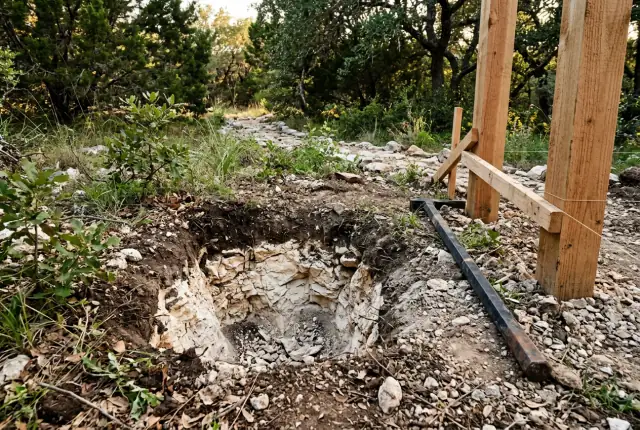
Rock adds a twist here. Much of Cedar Park has thin soil over limestone, so oak roots often run in a shallow layer above the rock. A hole doesn't have to be deep to cut through them. Our page on building on limestone covers what the digging involves.
How Much Room Should You Leave Around the Trunk?
More than looks right on day one. Trex's planning guide says to leave at least 3 to 5 inches all the way around the tree. Decks.com treats 1 inch between bark and board as the bare minimum, and it sizes the framed box to allow at least five years of growth.
Plan on two gaps, not one. The frame sits well back from the trunk and never moves. The deck boards reach in closer and get trimmed over the years. Fasten the boards around the opening with screws you can reach, so a saw and ten minutes buys the tree another few seasons.
Check the low limbs too. A branch that clears your head today will be thicker in ten years. If a limb has to come off for headroom, that cut belongs on the oak wilt calendar below.
Framing the Opening
A hole in a deck floor is framed like a stair opening in a house. The joists that would run through the trunk are cut short. They hang on a cross piece called a header, and the header hangs on thicker joists on each side called trimmers.
The American Wood Council's deck guide has the closest standard detail, written for a chimney or bay window. Headers may span up to 6 feet. With joists 16 inches apart, the trimmers on each side must be three boards thick. The header has to sit within 3 feet of where the trimmer is held up.
That last line is the catch with a tree in the middle of a deck. The frame wants support close to the opening, and the tree wants no holes close to the trunk. You solve it on paper. Shift the deck so the tree lands near the beam line, or near an outer edge, and the header can sit close to support that's already there.
A trunk in the true middle of a long span is past the standard details. That deck needs a design from an engineer, and the city will want to see it.
What the Opening Adds to the Parts Bill
These prices come from the parts list in our cost guide, which uses Cedar Park shelf prices. The opening is 4 feet square, sized for a trunk about 20 inches wide. It cuts two joists and thickens the two beside them.
| Thicker trimmers | 4 more treated 2x8x12 boards at $18.18. That's $72.72. |
|---|---|
| Two doubled headers | 2 treated 2x8x12 boards at $18.18, cut to length. That's $36.36. |
| Hangers for the cut joists | 4 at $2.83. That's $11.32. |
| Lumber and hangers added | $120.40, about 9 percent over the $1,289.48 parts bill. |
| Each post you add | One 6x6 post at $37.88, a base at $26.27 and four bags of footing mix at $7.97. That's $96.03. |
One added post$96
Framed opening$120
Whole 12 by 16 deck, parts$1,289
Two things aren't in that total. The header ends need heavier hangers than the ones in our list, and we haven't shelf priced them. The wood council's table asks for hangers rated at 1,155 pounds on a 2x8 trimmer. The slower hand digging isn't priced either, and that's where the real cost of a tree deck sits.
Treat the numbers as a floor, not a bid. The lumber for the opening is small next to the planning around the roots.
When Can You Cut Oak Limbs for a Deck in Texas?
From July 1 through January 31, and late fall is best. The Texas Oak Wilt Partnership says to avoid pruning or wounding oaks from February 1st through June 30th. Its list of wounds includes damage from construction, not only saw cuts. It names late fall as the best time to prune oaks.
The same guideline says to paint every cut and scrape right away, in any season. Any wound paint works if it goes on at once. Keep a can on the job from the first day, and tell the crew why it's there.
The stakes are high in this part of Texas. Texas A&M Forest Service says oak wilt has killed millions of trees across 76 Texas counties. Once it's in a live oak, it moves through joined roots at an average of 75 feet a year. One careless cut in April can cost you the tree and put your neighbor's oaks at risk.
So set the build calendar around the tree. Limb work and any digging that could scrape roots or bark fits best between now and the end of January. If the job can't start until spring, do the pruning this fall and build under the clearance later.
Do You Need a Permit or an Arborist?
The tree doesn't change the permit lines. Our Cedar Park permit guide lists them. You need one when the deck is attached to the house, 30 inches or more above the ground, or over 200 square feet. The city asks for a site plan with the application, so draw the tree and its root circle on it.
The city code does care about what building does to trees. Section 14.07.016 names a tree made unstable by severe trenching near the trunk during construction as a public nuisance. The same article sends protected and heritage trees to the subdivision rules. Call the permit office at 512-401-5100 before you remove a large tree or cut one hard.
An arborist is worth the visit on any large oak. The arborist society's guide says to bring one in during planning, before the holes are marked. An ISA Certified Arborist can map the big roots, cut the ones that must go cleanly and tell you if the tree is healthy enough to build around. Building a deck around a dying tree wastes the opening.
Which Layout Fits Your Tree
| Healthy oak where the deck has to go | Wrap it. Line the opening up near the beam or an edge. |
|---|---|
| Oak a few feet past the deck edge | Stop short. Notch the edge if you want the trunk closer. |
| Trunk in the middle of a long span | Get an engineer's design, or move the deck. |
| Thin soil over rock near the trunk | Hand dig, expect to move holes and keep them few. |
| Tree that looks thin or has dead limbs | Pay for an arborist's opinion before you pay for a deck. |
| Limbs in the way and it's spring | Wait until July, or prune in late fall and build after. |
Either layout pairs well with composite boards, since a deck under an oak stays damp and shaded longer than one in full sun.
We'll measure your oak with you, mark its root rings on the ground and draw the deck both ways on one sheet. Ask for a free estimate.
Move Cedar Park Deck Builders up in your Google results
Source Material
| What we cited | Where it came from |
|---|---|
| Root zone of one foot per inch of trunk, trees harmed by trenching, protected and heritage trees | City of Cedar Park Code of Ordinances, Article 14.07, Tree and Landscape Requirements |
| Inner quarter, inner half and full root zone limits, how to measure a trunk | City of Austin Development Services, Trees on Residential Property |
| Root depth and reach | City of Austin, How Tree Roots Work Part I |
| How building harms roots, footings that bridge roots, when to bring in an arborist | International Society of Arboriculture, Avoiding Tree Damage During Construction, 2021 |
| Oak wilt dates, wound paint, best season to prune | Texas Oak Wilt Partnership, Pruning Guidelines for Prevention of Oak Wilt |
| Counties with oak wilt, spread through roots | Texas A&M Forest Service, Prevent the Spread of Oak Wilt in Texas, February 2024 |
| Header span, trimmer thickness, hanger rating | American Wood Council, DCA 6 Prescriptive Residential Wood Deck Construction Guide |
| Headers and trimmers at floor openings | 2021 International Residential Code, Section R502.10 |
| Gap of 3 to 5 inches around the trunk | Trex, 5 Things to Consider Before Building a Deck Around a Tree |
| Nothing fastened to the tree, 1 inch minimum gap, five years of growth | Decks.com, How to Build a Deck Around a Tree |
| Shelf prices | Our deck cost guide, which names the store and the day we checked |
| Cedar Park permit lines | Our permit guide, which links the city documents |